What agencies and freelancers don't say clearly enough in the proposal — and what happens when they don't.
Every agency has had this conversation. Client comes in with an n8n subscription, a YouTube demo they watched twice, and absolute certainty that their non-technical team will maintain the workflows after you hand them over.
You know how this ends. You build it anyway.
This is the version of that story where we say the quiet part loud.
The Brief
A marketing agency came to us needing two automated AI workflows: one to monitor Google Ads performance and generate fresh creative when campaigns flagged, one to generate full campaign assets from a brief submitted in a Google Sheet.
The client had an n8n subscription. They wanted visual workflows. They wanted their team to maintain them without developer involvement long-term.
We took the project. We built in n8n. We should have pushed back harder.
The Non-Technical Team Myth
This is the pitch that sells n8n to clients: your team can open the workflow, see what it does, drag a node, make a change. No developer required.
Here's what actually happened on this project:
- Number of team members who opened the n8n editor after handover: 0.
- Number of times the client contacted us for changes after delivery: ongoing.
- Number of changes their team made independently: 0.
The "visual" interface that was supposed to empower a non-technical team looked like this:
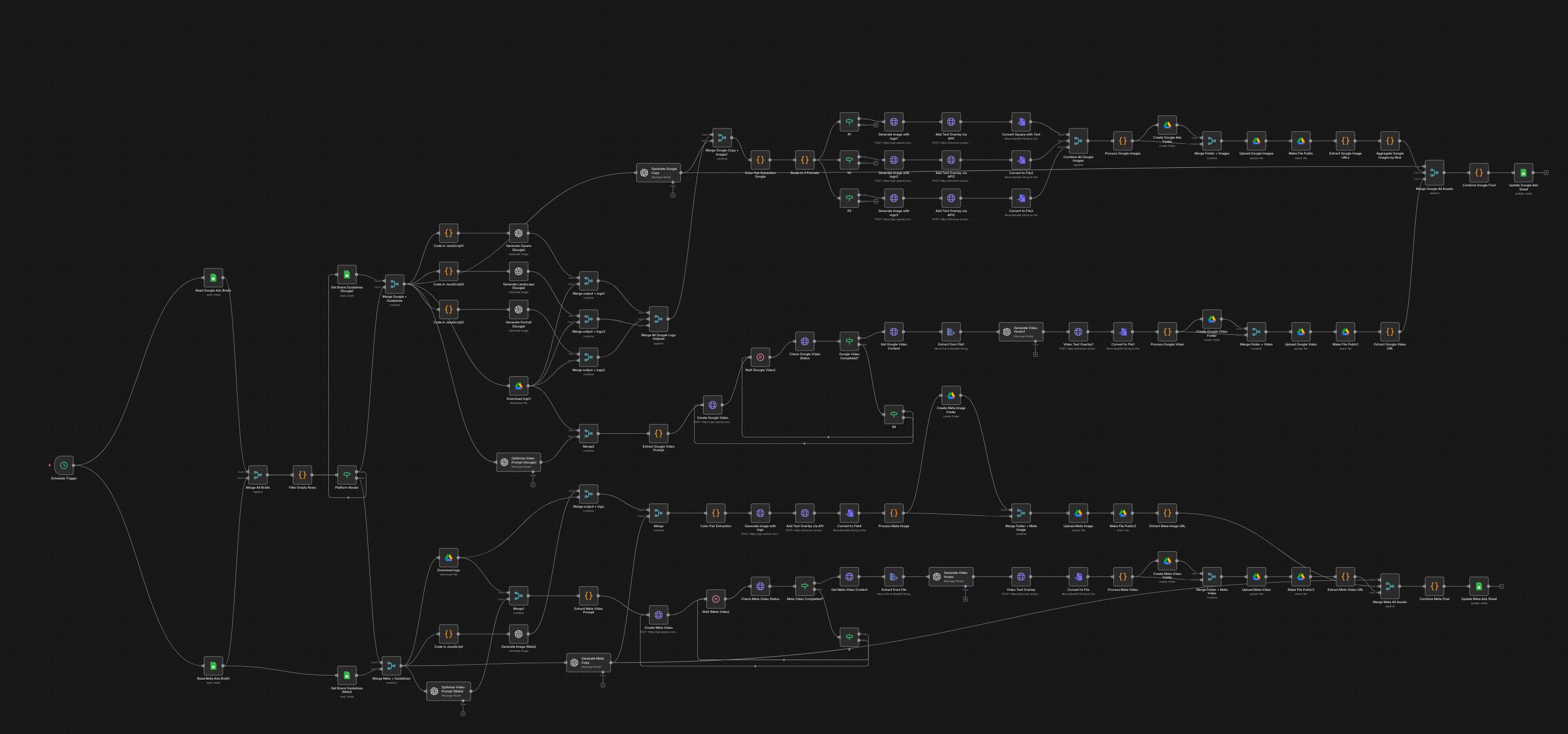
Nobody looks at 200 connected nodes and thinks "I can work with this." The visual interface is an asset when a workflow fits on one screen. It becomes a liability the moment it grows beyond that.
The non-technical team myth isn't an n8n problem specifically — it's a promise the "no-code" category makes that production complexity reliably breaks. The workflow was always going to be maintained by developers. The only question was whether those developers would have proper tools to do it.
What "No-Code" Actually Required
Let's be specific about what building this system in n8n actually involved:
JavaScript in every Function node. Every non-trivial data transformation required opening a code editor inside n8n and writing JavaScript. String manipulation, array filtering, JSON parsing, character limit validation — all JavaScript. We wrote code throughout the entire workflow. It just lived inside a visual tool that made it harder to read, test, and reuse.
A parallel Python service. n8n cannot do image manipulation. The workflows needed text overlays on generated images and videos. We built a separate Python FastAPI service to handle it. We were now maintaining two systems. The original "one tool, visual, simple" premise required a second codebase to function.
Manual rate limiting. n8n has no queue management. Hitting OpenAI's rate limit mid-workflow doesn't trigger a retry queue — it fails the workflow. The workaround was manually inserting Wait nodes with hardcoded timing delays between API calls. When rate limits changed, we updated delays by hand.
Error logging to a spreadsheet. n8n's error reporting tells you a node failed and when. That's it. No stack trace, no context, no data snapshot from the moment of failure. We built a manual error logging system that wrote failure details to a Google Sheet. The Google Sheet became our de facto observability layer.
By the end, the "no-code" system consisted of: n8n visual workflows, JavaScript in Function nodes, a Python FastAPI service, manual rate limiting logic, and a Google Sheet for error tracking. We had added complexity at every layer while removing the ability to properly test, version control, or debug any of it.
The Scope Creep Tax
n8n makes scope creep expensive in a way that code doesn't.
In Python, adding a feature means writing a function and calling it. Testing it means running a unit test against mocked APIs. Deploying it means a git push.
In n8n, adding a feature means dragging nodes, connecting them correctly, testing against live APIs (burning credits), and hoping the visual flow renders correctly after the changes. If the client changes their mind — "actually make it X instead of Y" — you disconnect nodes, reconnect differently, test again.
On this project:
- Week 1: "We need 3 images per brief"
- Week 3: "Actually we need 20 images per brief"
- Week 4: "Can you add custom font control?"
- Week 5: "Images need carousel frames"
In Python: each of these is an afternoon. In n8n: each was a workflow restructure with live testing. The same feature set would have been 60% faster to build and modify in code.
The Conversation We Should Have Had
Before the project started, we should have said this:
"You chose n8n because it looks like your team can maintain it. Here's what will actually happen: the workflows will grow to a size where no non-developer can meaningfully work with them. You'll still call us for every change. The n8n subscription adds cost without adding capability — you'd have a better system, more reliably, if we built it in Python. Your team gets an API they can call from a Google Sheet. They never need to open an editor."
Most clients, when this is explained clearly before the contract is signed, will take the recommendation. They don't have a strong attachment to the tool — they have a strong attachment to the outcome: automation that works without ongoing developer cost.
The mistake isn't agreeing to use n8n. It's agreeing to use n8n without first making the real trade-offs explicit.
What the Brief Should Look Like Going Forward
Before accepting any n8n project, run through this:
- Does the workflow require loops or iteration? → Push back, recommend code
- More than 20 steps? → Push back, recommend code
- AI/ML integrations with conditional logic? → Push back, recommend code
- Complex error handling required? → Push back, recommend code
- Will the client's team actually maintain it? → Ask directly, document the answer
If none of those apply — simple webhook chain, linear flow, under 15 steps — n8n is fine. Build it, hand it over, move on.
If any apply, have the conversation before the proposal goes out. Not after six weeks of fighting the platform.
The Bottom Line
The client wanted n8n because it looked simple. It wasn't simple to build in, maintain in, or extend. The team never touched the workflows. We wrote code throughout anyway. We built a parallel Python service because n8n couldn't do what the project needed.
The no-code promise is real for simple automations. For production AI workflows, it's a proposal-stage decision that compounds into development-stage pain.
Say it clearly in the proposal. Save six weeks.